Showing posts with label inca trail success. Show all posts

Friday, July 17, 2015

The Inca Trail is crossed by 500 people every day


The National Service of Natural Protected Areas (SERNANP) reported that around 500 people walk every day the Inca Trail towards Machu Picchu. According to Pedro Gamboa, Head of Sernanp, from this group only 200 are foreign people, the rest are porters that carry baggage’s and guides that help the visitors on the route towards Machu Picchu.
In this Inca trek the porters are the ones that carries the food, and supplies needed during the trek. They do not reach the citadel, only the tourists reach the final section of the trip to get to MachuPicchu.
According to the report, the age of the tourists are not an impediment for people that want to do the Inca Trail in spite of the physical effort that it requires. The route is through the Urubamba Valley, amidst beautiful natural scenery and Incan architectural remains.
The Sernamp is working so the protection rules include the whole course area so the natural area is not affected in any case. The measure includes the signposting and the maintenance of the road, sanitation facilities equipped with the latest technology ecological standards.

For more information about the Inca Trail and to have access to the diverse tours, you can enter to following link: Inca Trail

Friday, June 26, 2015

Qhapaq Ñan, the Inca heritage that has survived the test of time


The Incas are known worldwide for the citadel of Machu Picchu. Besides its beauty, the archaeological site is the best example of architectural knowledge had by the ancient Peruvians.
Like the citadel, Qhapaq Ñam is another important Inca vestige that just turned one year after having been named a World Heritage Site by UNESCO. This is the road network which used to connect all the Tahuantinsuyo, from Colombia to Argentina, passing through Ecuador, Peru, Bolivia and Chile.
But the importance of these roads lies not only in its history but what it represents for Peru, even to this day. “Some of the roads are still used even today by the surrounding communities. It is a heritage that is kept alive and allows us to connect these villages,” explains Giancarlo Marcone, general coordinator of the Qhapaq Ñam Project.
Marcone emphasizes the role of these pathways in the relationship between our past and present. “Often the traditional story is told as a break between the Andean, the colony and who we are today. But there are aspects such as the Qhapaq Ñam where there is no such break, as we continue to grow over the same past and represents the unity of such diversity.”
While the most well known ways of this great network of roads are found in Cusco, there are other sections that represent an enormous tourist potential for the country. For example, the route that passes by Lake Titicaca in Puno or the section between Vilcashuamán and Pisco. Even close to Lima you can see part of this road coming from the central highlands and culminated in the archaeological site of Pachacamac.
Of the sixty thousand kilometers that make up the Qhapaq Ñam, nearly half run through Peruvian territory. They are about 23 kilometers of roads we have in Peru including the most important point, Cusco. And even now these routes are preferred by trekkers and backpackers, the plan of the Qhapaq Ñan Project. according Marcone, is to recover those alternative ways to attract more visitors and assist the development of local communities through tourism.

Tours to Inca Trail:

Tuesday, March 24, 2015

Three alternative treks than the Inca Trail


The famous of the Inca Trail is worldwide. However, there are other wonderful routes to the magnificent Machu Picchu. Here you will find three alternative treks to challenge the height and yourself.

The Salkantay Trek, less known than the Inca Trail, but equally significant in religiousness, in its peak people stop to offer to Pachamama or the mother earth. The mount Salkantay, named one of the “Top 25 Treks in the world" for the National Geographic, became very popular because it has no space limitations nor permissions as the Inca Trail. Be part of Mollepata's village to walk across Cusco and the Cloud Forest, where it is possible to see wonderful landscapes.

Another great alternative trek is Lares. With great views of high lakes and valleys. As appreciated as Salkantay, this route has less-crowded of people than the previous one. Deep located in the mountain of Urubamba, hiking Lares will allow us to live through the meaning of the Inca history and the tradition of their people. The trek lasts approximately 2 or 3 days. Started in Lares, a town with hot springs ending in Ollantaytambo.


The difficulty of this route increases with regard to the previous ones. It takes 3 to 5 days to explore. On this trek appears the most impressive waterfalls and Inca ruins. It is said that the Inca Quarries of Cachicata served to carve almost perfect big rocks that can be found in the Inca fortresses.

Travel to the Inca Trail with these tours: http://www.inkanatura.com/en/inca-trail-tours 

Friday, February 20, 2015

New app helps hikers explore Inca Trail in Cusco


Hikers coming to Machu Picchu via the Inca Trail, one of the most popular tough treks on earth, can now download a new app named Camino Inca before heading out on their journey.

Users will be able to access virtual maps on their smart phones or tablets, a useful tool for those attempting the steep climbs and descents to the renowned Sun-Gate overlooking Machu Picchu.

There are several maps available in the app inducing, among others, the 4-day Traditional Trail, as well as the Salkantay and Choquequirao treks, which take 5 and 8 days, respectively.

Once downloaded, the maps can be viewed at any time without the need to be connected to the internet.

Travelers can also find information about archaeological sites, description of local birds and a photo gallery.

The Hi-Tec Camino Inca, available free of charge on iOS or Android, was created by the photographer Walter West.

Tours to Inca Trail:  Inca Trail Classic 4D/ 3N - all camping

Source: Andina


Friday, January 23, 2015

Trekking From Lodge to Lodge in the Mountains of Peru


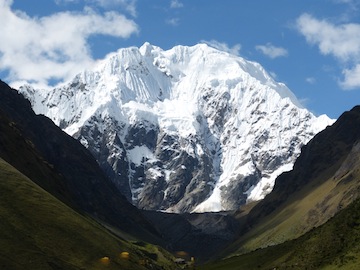
As I sat in the spa sipping a pisco sour, I looked down the valley to the huge, snow covered monolith at the end. Mt. Salkantay, the highest peak in the region, would loom over us for the next two days as we worked our way up and over the pass that bears its name. I could barely make out the trail as it snaked down the valley. It didn't look so tough, I thought, then reminded myself that was only the beginning.
2013-10-02-P1010556.JPG

At 15,213 feet, Salkantay Pass would be the highest I had ever been without the aid of an airplane or mind-altering substances. That we would start from an elevation of 12,690 feet and head steadily up from there didn't make me feel any better. But that was tomorrow. Right now I had a hot, churning spa to melt into and a pisco sour to drink.

Tuesday, January 13, 2015

About 175,000 travelers arrived via Inca Trail to Machu Picchu in 2014


Nearly 175,000 tourists, national and foreign, made their way to the grounds of Machu Picchu by taking the Inca Trail, according to the National Service of Protected Natural Areas by the State (SERNANP).
Out of a total of 2.6 million tourists who visited Cusco in 2014, 175,000 decided to take the ancient path weaving through jungle and Andes ecosystems, paved by the Incas themselves.

Monday, March 29, 2010

Math students learn lessons on the Inca Trail


Eric Kuennen wanted his students, all future math teachers, to view the world of mathematics from a different perspective. This desire to shake things up led Kuennen and 16 of his students to the mountains, jungles and deserts of Peru.Read the full story and watch videos at College of Letters & Science Special Reports“We really need to go someplace that’s different from the U.S.,” said Kuennen, an assistant professor of math at the University of Wisconsin Oshkosh, who along with Dr. Jennifer Szydlik, led the students on a study tour in Peru last summer.

“We need to take them out of their comfort level.”In the four-week course “International Comparative Mathematics Education Seminar (Math Education in Peru),” students spent the first week of class in Oshkosh, where they studied theories and conditions of learning and the theory and practice of teaching. The next two weeks took place in Lima, the capital of Peru, where the students attended class at the Universidad del Pacifico and visited public and private elementary and secondary schools. The students also were given an opportunity to teach a class to Peruvian students. 


The last week was spent traveling Peru where they stayed at a jungle lodge in the Peruvian Amazon Rainforest, explored the Inca ruins and hiked the Inca Trail to Machu Picchu.Kuennen said going to Peru, for many of his students, was a journey in discovery.“It is completely different from what they are used to in Oshkosh, in Wisconsin,” he said. “The city of Lima is a huge sprawling city with lots of lower-income, kind of Third World neighborhoods. It was an eye-opener for our students to see that so much of the world lives in a completely different standard of living than what we’re used to.”

More Resources Tour SuggestedInca Trail Map